
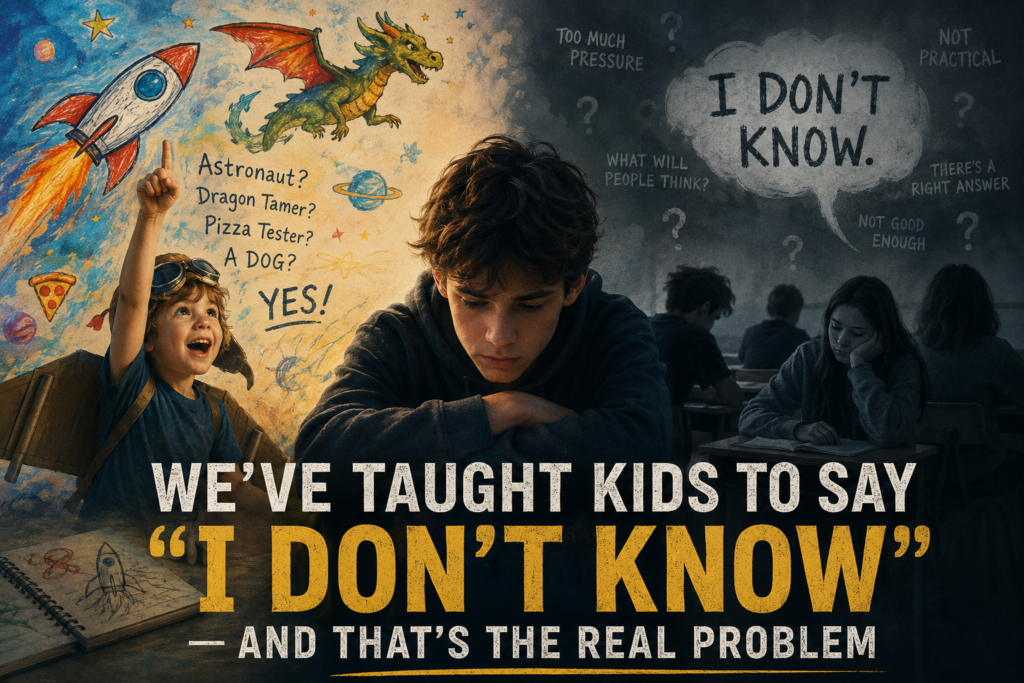
Ask a room full of five-year-old what they want to be when they grow up.
You’ll get astronauts. Dragon tamers. Professional pizza testers. Kids who want to be dogs. The answers will be loud, specific, and completely unfiltered by reality. Every single hand goes up.
Ask the same question to a room full of teenagers.
Silence. Shrugged shoulders. A lot of “I don’t know.”
Something happened in between. And it wasn’t just growing up.
“I Don’t Know” Isn’t Ignorance. It’s Armor.
I work with a lot of kids. Coach them through all kinds of stuff — performance, mindset, figuring out who they are and what they actually want from their lives.
And the phrase I hear more than any other?
I don’t know.
At first, it sounds like confusion. Like they genuinely haven’t thought about it. But the longer I do this work, the more I’ve come to understand what “I don’t know” actually means when a kid says it.
It means: I’ve learned that having an answer is risky.
It means: The last time I said what I really thought, it didn’t go well.
It means: This is the safest thing I can say right now.
“I don’t know” isn’t ignorance. It’s a defense mechanism. It’s what you say when you’ve been told — directly or indirectly, once or a thousand times — that your real answer isn’t welcome here.
How Curiosity Gets Coached Out of Kids
Nobody sits a child down and says “stop caring about things.” It doesn’t work like that.
It happens slowly. Quietly. Through a thousand small moments that add up to one loud message.
It’s the passion project that got laughed at. The dream that got called unrealistic. The genuine answer that was met with an eye roll, a redirect, or a “that’s not practical.” It’s years of school systems that reward the right answer over the honest one. Years of being graded on performance instead of curiosity. Years of learning that the goal isn’t to discover what you think — it’s to figure out what the room wants to hear.
By the time most kids are teenagers, they’ve become experts at reading the room. They know how to give you the answer that ends the conversation without costing them anything.
And “I don’t know” ends the conversation every time.
The Deeper Problem: Disconnection
Here’s what worries me most about this pattern.
It’s not just that kids don’t know what they want to do with their lives. That’s normal. That’s actually fine. Nobody at sixteen should have it all figured out.
What worries me is that so many of them have lost the ability to connect — with themselves, with the people around them, with anything that asks them to be honest about who they are.
They can’t tell you what they like because they’ve spent years suppressing the process of noticing what they like. They can’t tell you what excites them because excitement became something to be managed and hidden, not expressed. They can’t connect with their parents or peers in any real way because real connection requires vulnerability, and vulnerability requires knowing yourself well enough to show up honestly.
When you smush curiosity out of a kid long enough, you don’t just take away their hobbies. You take away their compass.
And a person without a compass doesn’t go somewhere wrong. They just stop going anywhere at all.
What We Can Do Differently
The good news is that curiosity doesn’t die. It goes underground.
In almost every kid I’ve worked with who leads with “I don’t know,” there’s something underneath that answer. A thing they light up about when the pressure is off. A topic they’ll talk about for twenty minutes if you catch them off guard. A moment where their face changes before they can stop it.
The work isn’t to give them answers. It’s to make it safe to have them again.
That starts with a few simple shifts:
Ask better questions. Instead of “what do you want to be?” try “what’s something you’d do even if nobody was watching?” Instead of “what are you good at?” try “what’s something you could talk about for an hour without getting bored?” Smaller questions, lower stakes, more honest answers.
Celebrate the noticing. When a kid expresses a preference — any preference, even a small one — treat it like it matters. Because it does. Every “I kind of like this” is a thread. Pull it gently.
Stop rushing them toward conclusions. The goal isn’t to get them to declare a major at sixteen. The goal is to help them stay curious long enough to find out what’s worth being curious about. Give them permission to explore without a destination.
Model honesty yourself. Kids learn disconnection from adults who are disconnected. If you want them to say what they actually think, let them see you do it first. Admit when you don’t know. Share what you’re still figuring out. Make “I’m not sure yet” sound like wisdom instead of weakness.
Curiosity Is a Skill — And It Can Be Rebuilt
I’ve watched kids who came in with nothing but shrugged shoulders start to find their edges again. It doesn’t happen overnight. It takes consistency, patience, and a lot of questions that don’t have wrong answers.
But it happens.
Because here’s the truth: those kids who say “I don’t know” all the time? They do know. Somewhere underneath all the armor and the conditioning and the years of being redirected — they know exactly what moves them. They just stopped trusting that it was safe to say so.
Our job — as coaches, parents, teachers, mentors, anyone who works with young people — isn’t to give them a path. It’s to help them trust themselves enough to find one.
The curiosity was always there. We just have to stop beating it out of them.
Most people sleepwalk past their own instincts. They dismiss the warmth they feel around certain work as nostalgia or distraction. But those signals aren’t noise — they’re data. The things that light you up aren’t accidents. They’re arrows. And the people who build lives they’re proud of are usually the ones who learned, early enough, to follow them.
Be curious. Learn often. Live deliberately.
Brett Solomano

