

The house is filling with water, but you won’t leave because you’re afraid of what’s outside. You know the water is rising. You can feel it around your ankles, then your knees, then your waist. But the unknown outside feels more dangerous than the known disaster you’re standing in. That feeling of being frozen while the pressure builds is what psychologists call mental paralysis.
This is the safety paradox, and if you’re smart, you’re especially vulnerable to it.
Learning how to overcome fear and procrastination often starts with understanding why your own intelligence is working against you.
Why Being Smart Makes You Vulnerable to Mental Paralysis
Here’s what nobody tells you about being intelligent: it’s a double-edged sword when it comes to overcoming procrastination and fear. Smart people are exceptional at something that keeps them stuck—they can rationalize anything.
They can build airtight logical arguments for why now isn’t the right time. They can identify every potential pitfall. They can think through seventeen scenarios before breakfast and find reasons why none of them will work. And here’s the really insidious part: they can talk themselves into taking action and then out of it in the same sentence.
“I should just create a simple PDF lead magnet and run a small ad campaign… but everyone else is doing beautiful Google Sheets and habit trackers, and mine needs to stand out, so maybe I should spend more time on it, but then I’m just procrastinating, so I should just do it, but what if nobody signs up and I waste money…”
Sounds familiar?
Smart people get stuck in what I call mental mastication—chewing on the same thoughts over and over, creating the illusion of progress while actually remaining frozen. The thinking feels productive. The analysis feels necessary. But it’s just another form of hiding, and this is what analysis paralysis actually looks like from the inside.
This isn’t just a feeling. Researchers have traced how choice and information overload physically overwhelm the brain’s working memory, making a decision genuinely harder to reach the more options and angles a person tries to hold in mind at once.
The Illusion of Safety
When I work with coaches and entrepreneurs on emotional intelligence and fear, I ask them a simple question: “Convince me that you’re unsafe right now.”
They’ll talk about money running out. About the fear of failure. About what people might think. About being judged or rejected or ridiculed.
So I ask again: “But are you actually unsafe? What’s the worst that will happen right now? Is the building on fire? Or are you just afraid of discomfort?”
They will usually giggle a little and say “no, but…” There will then be a little justification, and I’ll smile and nod along, and then I’ll playfully respond with “so are you in danger or not?” The silence that follows is deafening, and the “nooo” complete with the eye roll, is telling a simple truth that was hiding all along.
See, your nervous system can’t distinguish between actual danger and perceived threat. It treats the possibility of someone saying “no thanks” to your offer the same way it treats a bear attack. Both trigger the same protective response: freeze, hide, stay small.
Back 5000 plus years ago, saying the wrong thing to the wrong person might mean exile, banishment, and certain death from our tight clan or tribe or just hundreds of people.
But right now, you’re not in actual danger. You’re just afraid of feeling uncomfortable emotions—and your intelligence gives you sophisticated ways to justify that avoidance.
This gap, between what feels dangerous and what actually is, is where fear of failure quietly does most of its work.
There’s No Such Thing as Self-Sabotage
One of my favorite teachers, Dr John Demartini, taught me something that changed my perspective: there’s no such thing as self-sabotage. There are only competing rewards.
This idea comes from the Demartini Method, a framework built around the idea that people don’t act against their own interest so much as they act toward whatever reward feels most weighted in the moment. It’s one of the frameworks I lean on most in this work, and you can read more about it and the other approaches that shape my coaching on my resources page.
You’re not sabotaging yourself by scrolling social media instead of creating your offer. You’re choosing the immediate reward of distraction, connecting with friends and having a laugh over the delayed reward of business growth. You’re not sabotaging yourself by over-preparing. You’re choosing the reward of feeling in control over the reward of having results.
And here’s the one that hits hardest: sometimes staying stuck IS the reward. There’s a certain comfort in the familiar pain of “not there yet.” It’s safer than risking real failure. It’s easier than being seen. It’s less vulnerable than trying and discovering it wasn’t enough.
Some people go back to university three, four, five times—getting degree after degree—because “not ready yet” feels safer than “I tried and it didn’t work.” The perpetual preparation becomes its own protective cocoon. An intrinsic loop of motivation and validation to keep repeating the same pattern.
Behavioral researchers have a name for part of this pattern: delay discounting, our tendency to weigh a smaller reward available right now more heavily than a larger reward that’s still off in the distance. Procrastination fits neatly inside that frame. The distraction isn’t winning because you’re weak. It’s winning because it’s closer.
The Mental Paralysis Trap Smart People Fall Into

Smart people excel at creating mental paralysis through analysis. They identify every variable, consider every outcome, and then… freeze. Because with perfect information comes perfect awareness of all the ways things could go wrong.
Here’s what I see constantly: a service provider knows exactly what they need to do. Build a simple lead magnet. Send some emails. Run a small ad campaign. Have conversations with potential clients. The steps are clear.
But then the internal dialogue starts:
“What if I build it and nobody wants it? What if people think I’m just another person trying to sell them something? What if I spend money on ads and get zero return? What if someone is mean in their response? What if this is just another failure to add to my collection?”
Notice what’s happening? The intelligence that should be an asset becomes a liability. Every “what if” is a sophisticated rationalization for inaction. Every concern is valid enough to justify waiting. And waiting. And waiting.
The “There” That Keeps Moving
Here’s a truth that smart people struggle with: you’re never going to feel ready. The “there” you’re hoping to reach keeps moving.
You think: “Once I have the perfect lead magnet, THEN I’ll promote it.” Then it becomes: “Once I have a better email sequence, THEN I’ll run ads.” Then: “Once I have more testimonials, THEN I’ll charge more.”
Some things do need to happen in order at times, yes. The goalpost of “enough” never stops moving because your intelligent mind can always identify one more thing that could be improved, perfected, or optimized.
Meanwhile, less intelligent people, or rather, people who don’t let their intelligence become an excuse, are out there doing the work. Building imperfect offers. Having awkward sales conversations. Getting rejected and moving on. Making money.
I’m sure you know plenty of people less qualified than you who are out there absolutely crushing it, right? All they probably did was step up more than you and didn’t get stuck in analysis paralysis.
Breaking Free from the Safety Paradox and Overcoming Mental Paralysis
So how do smart people overcome this? How do you stop talking yourself out of action in the same breath you talk yourself into it?
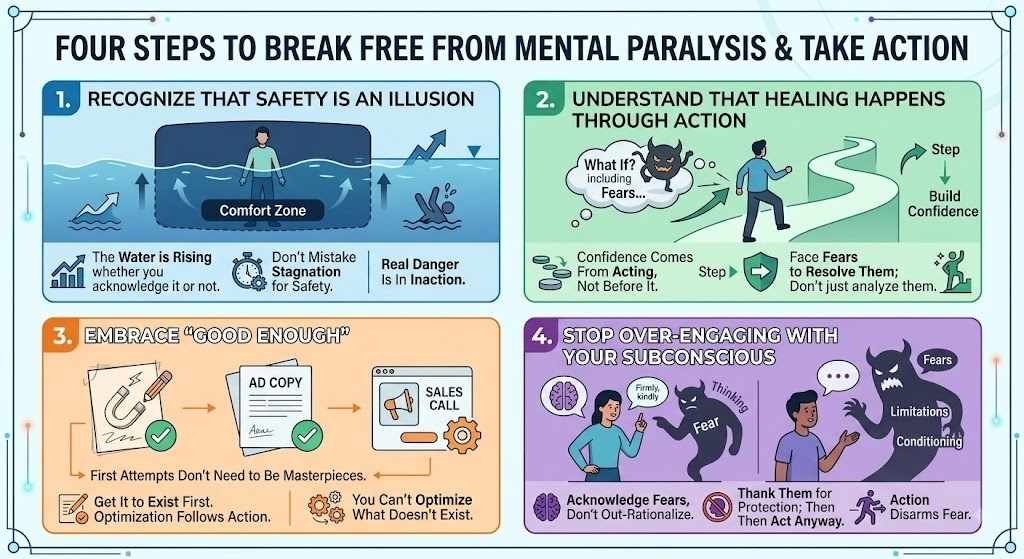
1. Recognize That Safety Is an Illusion
You’re not safe in your comfort zone; you’re slowly drowning. The water is rising whether you acknowledge it or not. The real danger isn’t in taking action; it’s in mistaking stagnation for safety.
2. Understand That Healing Happens Through Action
You’re waiting to feel confident before you act, but confidence tends to come from acting, not before it. You’re waiting to resolve your fears before you step forward, but fears tend to resolve by being faced, not analyzed.
3. Embrace “Good Enough”
Your first lead magnet doesn’t need to be a masterpiece. Your first ad campaign doesn’t need perfect copy. Your first sales call doesn’t need to be smooth. It just needs to exist. You can’t optimize what doesn’t exist yet.
4. Stop Over-Engaging With Your Subconscious
Yes, you have fears. Yes, you have limiting beliefs. Yes, you have conditioning that wants to keep you small. Acknowledge it. Thank it for trying to protect you. Then act anyway. You don’t need to out-rationalize the fear; you need to act despite it.
The Real Question to Stop Procrastinating
Here’s what it comes down to: Are you willing to be uncomfortable in service of your goals? Or will you let your intelligence construct increasingly sophisticated reasons why now isn’t the right time?
Because here’s what I’ve learned coaching people through procrastination and fear: the difference between people who succeed and people who stay stuck isn’t intelligence, skill, or preparation.
It’s willingness. Willingness to be seen. Willingness to be judged. Willingness to fail. Willingness to be uncomfortable.
Your brain will always prefer the familiar discomfort of staying stuck over the unfamiliar discomfort of growth. That’s not self-sabotage. That’s not even a problem. That’s just how nervous systems work.
But you—the conscious you, the part that wants something more—you get to choose whether you let that preference run your life.
The house is filling with water. Your intelligence can keep constructing reasons why it’s safer to stay inside. Or you can open the door and walk out.
What will you choose?
Ready to Stop Overthinking and Start Moving?
If you recognized yourself somewhere in this – in the mental mastication, the moving goalposts, the seventeen scenarios before breakfast – that recognition is worth something. It’s usually the first sign that you’re ready for something different.
This is exactly the work I do with smart, capable people who’ve gotten very good at thinking their way around action instead of through it. Because their mental paralysis has quietly convinced them that one more round of preparation will finally make the risk disappear. It won’t.
If you’re willing to find out what happens when you act instead of analyze, book a free discovery call and let’s talk about what you’re actually protecting yourself from.
Your greatest creation could lie just behind the curtain of fear you’ve convinced yourself is safer not to look behind.
Frequently Asked Questions
Analysis paralysis is what happens when you have so much information and so many possible angles that deciding becomes harder than not deciding at all. It’s not a lack of intelligence; in my experience, it’s often the opposite: it’s intelligence without a clear direction.
Because they’re good at finding reasons, and reasons are hard to argue with, even your own. A smart brain can build a convincing case for waiting just as easily as it can build a case for acting. The problem isn’t the thinking. It’s mistaking thinking for progress and never actually acting upon your ideas.
One of the best ways to stop procrastinating is to start creating anything. Start smaller than feels comfortable, not with the perfect lead magnet, but with a rough one. Confidence tends to show up after you act, not before, so waiting to feel ready is usually just waiting in vain.
To overcome fear and procrastination, I advise you to first separate what’s actually dangerous from what’s just uncomfortable. Rejection, judgment, and a sale that doesn’t land can all feel like threats, but they’re rarely dangerous. Once you can see that difference clearly, the fear tends to lose some of its grip.
Self-sabotage is not real in the way most people think about it. What looks like self-sabotage is usually a competing reward. Staying stuck can feel safer than trying and falling short, so the question isn’t “why am I sabotaging myself,” it’s “what am I currently getting out of staying here?”
~ Be curious. Learn often. Live deliberately.
Brett Solomano

