

I knew I wanted to become a coach. I wanted to help people develop emotional intelligence, overcome fear in business and personal life, and beat procrastination.
When I would introduce myself, though, there was always a “well…” or an “I’m a … but…” statement where I just didn’t quite have the confidence to own what I wanted and knew deep down.
I felt I became a coach, however, when I realized I was truly ready to coach anyone, not because I was that good of a coach, but because I was ready to stick my neck out and coach anyone, anywhere, anytime. I was ready to tell the world; to step up, show up, and let people react however they would.
Similarly, I realized I finally became a man in my early thirties after going through a business transition where I had to step up and take responsibility. Obviously, I became a man at 18, at 21 legally, and a few other times in my life, but this one stood out.
The question that changed everything was simple but powerful: What am I truly willing to take responsibility for?
That’s the moment I understood what taking responsibility in business actually looks like — and that question measures your character in ways nothing else can.
The Museum You’re Building: Why Fear and Procrastination Take Root
Here’s what I’ve noticed working with coaches and entrepreneurs trying to overcome procrastination and fear: they are often unconsciously building a museum of failures in their minds.
Every attempt that didn’t work perfectly, every campaign that underperformed, every moment of rejection—it all gets carefully curated and displayed as evidence of why they should stay small and that they “aren’t there yet”.
But here’s my question: if you have a museum of failures, where’s your museum of successes? Can I buy tickets to that one? What’s the business plan for showcasing everything you’ve accomplished, every client you’ve helped, every moment you showed up despite the fear?
The truth is, both museums exist. But we spend all our time touring the one that keeps us stuck.
This isn’t just anecdotal; research on entrepreneurial well-being has found that fear of failure directly fuels procrastination, and that procrastination in turn negatively affects an entrepreneur’s overall well-being.
Why Not Me? The Question That Helps You Overcome Fear in Business
One of the most powerful shifts in overcoming fear happens when you move from “Why me?” to “Why NOT me?” If that person can build a successful business, why can’t it be you? If they can charge premium rates, create compelling offers, and attract ideal clients—what makes you fundamentally different?
The answer, usually, is nothing. Except you’re waiting for permission that’s never coming.
Learning how to overcome fear in business often starts with taking action and putting yourself out there. It’s not that second or third degree where you’ll finally be ready, and it’s not that magical invitation that will just show up on your doorstep.
Think of it like this: you’re helping everyone else onto the lifeboat while refusing to get in yourself. That ultimate self-sacrifice? It serves no one. You can’t uplift others if you won’t lift yourself up first.
The Arrogance Paradox: Overcoming Fear as a Coach or Service Provider
There’s a certain arrogance required to tell someone they have a problem and that you can help them with it.
“Hey, I see you’re struggling. I can help you with that.”
That statement requires confidence that feels foreign to natural helpers, uplifters, and people-pleasers. But that “arrogance” isn’t ego — It’s willingness. It’s responsibility. It’s you stepping into your role as someone who has value to offer.
When I work with service providers on emotional intelligence, the core of most fear and procrastination coaching, I often see this pattern: their desire to avoid being an “inconvenience” has become more powerful than their desire for success.
They’d rather stay invisible because they “don’t want to cause more problems” or be a nuisance than risk someone being annoyed by their outreach.
But people need what you have. And staying small because you’re afraid of judgment? That’s not humility; that’s hiding.
Becoming Tenacious: The Trait Every Fear-Free Entrepreneur Shares
If you study anyone who’s achieved significant success—love them or hate them—you’ll notice they share one quality: they’re tenacious. (Or more colloquially known as: unfuckwithable.) Criticism rolls off their backs. Rejection doesn’t derail them. They have a clear vision, and other people’s opinions simply don’t have the power to stop them.
Donald Trump (*love him or hate him…) right now has had honorary statues and personal monuments made of him and even had the negative side of that, like that statue of him holding hands with Epstein and people degrading his buildings. He will gladly tell you all about his successes, and I’m sure he will tell you all about his haters too. He enshrines both sides.
And, to Donald Trump’s credit, he rarely looks flustered. He shuts things down and tells you how it’s going to be.
Now, I’m trying to remain apolitical here (which is hard to do when you bring up someone like Donald Trump), but can you at least admit (without adding a “yes but…” or “yes and…” statement) that he is tenacious in going for what he wants?
Being tenacious doesn’t mean being callous or ignoring feedback. It means understanding a fundamental truth: some people will love you no matter what you do. Some people will hate you no matter what you do. And there’s a small sliver in the middle who might say, “Actually, you’re pretty cool. Can we chat some more?”
Those are the people you’re looking for. But you’ll never find them if you don’t open your mouth and start talking. This is really the heart of learning how to overcome fear in business and overcome procrastination — action comes before certainty, not after.
Now, imagine yourself in 10 years time. Would you be able to then look back at these moments and talk equally about the good and the bad from your past and how they fueled your journey to where you are now?
What Are You Truly Willing to Take Responsibility For?
Back to that question that changed my life: What am I truly willing to take responsibility for?
Not what you’re capable of. Not what you’re skilled at. What are you willing to be responsible for?
Because here’s the thing about stepping up: it’s not about being ready. It’s about being willing. I was willing to coach anyone, anywhere, anytime before I was “qualified” by some external standard. I took responsibility for the outcome before I had all the answers.
That willingness is what separates people who build thriving businesses from people who stay perpetually “almost ready.” At its core, taking responsibility in business means choosing to act before you feel ready, not after.
The Practice: 5 Steps to Overcome Fear and Procrastination
So how do you actually do this? How do you overcome fear in business and procrastination that keeps you playing small?
1. Recognize Your Nervous System’s Bias for the Familiar
Your nervous system will always prefer the familiar over the unknown—even when the familiar is slowly drowning you. Your brain interprets “safe” as “what I already know,” not “what’s actually good for me.”
2. Separate Discomfort From Danger
Understand that you’re not actually unsafe. No one has a gun to your head. You’re afraid of judgment, rejection, and failure—which are uncomfortable but not dangerous. When you can separate discomfort from danger, action becomes possible.
3. Ask Yourself Daily: “Who Am I?”
Ask yourself daily: “Who am I?” And answer with conviction: “I’m a coach. I help people transform their lives.” Say it until it feels true. Say it until it IS true.
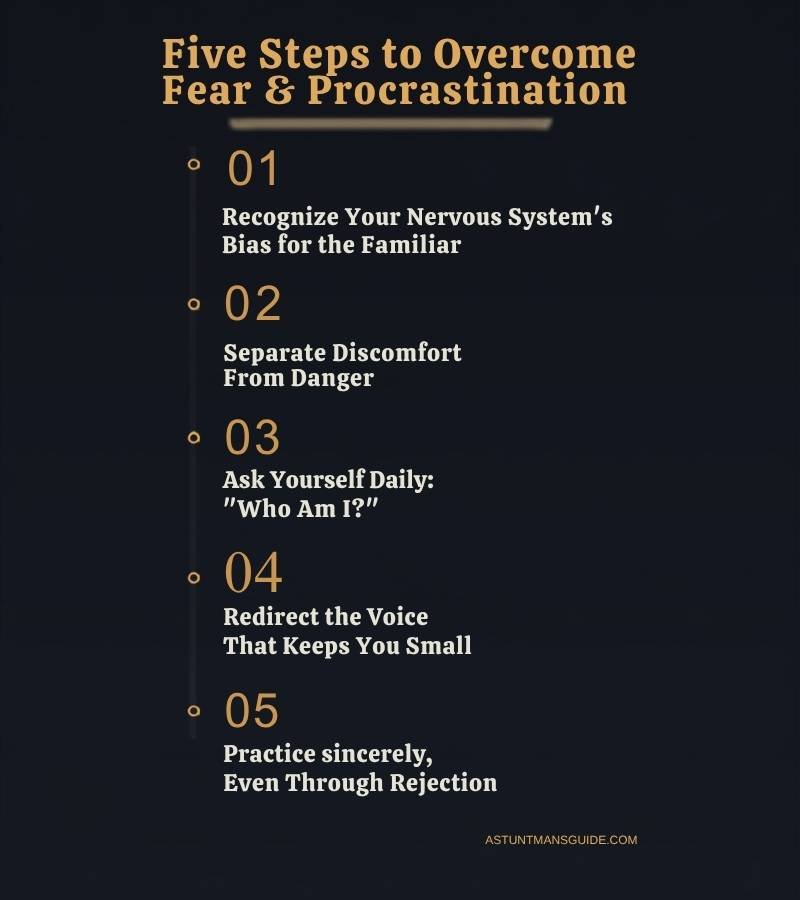
4. Redirect the Voice That Keeps You Small
Invite the protective part of yourself, that voice that keeps you small, into the conversation. Thank it for trying to keep you safe. Then ask it to help you level up instead of holding you back.
You don’t have to silence it; you have to redirect it. This is exactly what good fear and procrastination coaching does.
5. Practice Sincerely, Even Through Rejection
Practice sincerely offering your services, asking for help, offering advice, and telling everybody within earshot what you do every day for the rest of your life. The key word there is sincere. You’ll get rejected and ignored. You’ll hear the word no. Sit with it. It’s fine. Really.
If you truly love what you do, you’ll find others to talk about it with and find ways to serve them.
The Real Risk of Staying Small
Every day you wait to overcome fear and make yourself known, the cost compounds. It’s not just the client you didn’t reach out to, or the offer you didn’t send.
It’s the version of your business, and the version of you, that never gets to exist because you were busy waiting for permission that was never coming.
Entrepreneurship research frames hesitation as a form of risk aversion, a learned response to avoid the discomfort of a potential failure, rather than a rational conclusion of actual odds.
Staying small feels safe, but it isn’t; it’s just slower. The fear doesn’t go away when you wait; it just gets more familiar, more comfortable, and harder to notice. Meanwhile, the people who need what you have are still out there, still struggling, still waiting for someone willing to raise their hand and say “I can help you with that.”
Taking a bet on yourself isn’t selfish. It’s the prerequisite for helping anyone else.
So ask yourself: What am I truly willing to take responsibility for?
Your answer will determine everything.
Ready to Stop Waiting and Start Building?
If you’ve read this far, some part of you already knows you’re done touring the museum of failures. You’re ready to show up and take responsibility for what happens next.
That’s exactly the work I do with coaches and entrepreneurs who are tired of playing small and ready to build the business (and the confidence) they know they’re capable of.
If you’re willing to take that step, book a free discovery call and let’s figure it out together.
Frequently Asked Questions
You don’t get rid of it. In my experience, fear doesn’t leave the room; you just stop needing it to. Start by asking what’s actually at risk versus what only feels at risk, because rejection is uncomfortable, but it’s rarely dangerous. Once you can see that gap clearly, action tends to get a lot more available.
Procrastination is usually not laziness but protection. The brain tends to read “unfamiliar” as “unsafe,” even when the familiar thing is what’s quietly costing you the most, and procrastination is often just fear wearing a more socially acceptable outfit.
Fear of failure often comes from the anxiety around a specific set of outcomes, like financial loss, public rejection, or being seen to fail. That anxiety is what keeps someone from acting on an idea they actually believe in, and over time lowers confidence in their own ability to follow through.
To get over the fear of promoting yourself, I would suggest naming what’s actually happening. Most people I’ve sat with aren’t afraid of selling, but of being a burden. There’s a difference, though, between imposing on someone and offering them something they genuinely need. One approach that tends to work is reaching out anyway, expecting some no’s, and paying attention to those who lean in.
Fear of failure tends to increase procrastination and can wear down the confidence that drives entrepreneurial follow-through. What I’ve found, watching this up close, is that the damage isn’t the fear itself but what stays undone while you’re waiting to feel ready.
~ Be curious. Learn often. Live deliberately.
Brett Solomano

